Start with a shape.
End with a system.
Primitives, heightfields, seeded scattering, deformations and GPU instancing. Every operator stays in the graph, ready to change.
Explore procedural instancing ↗ STRATUM FXOpen studio ↗
A node-based 3D workspace for procedural ideas.
Shape geometry. Explore motion. Keep the whole recipe.
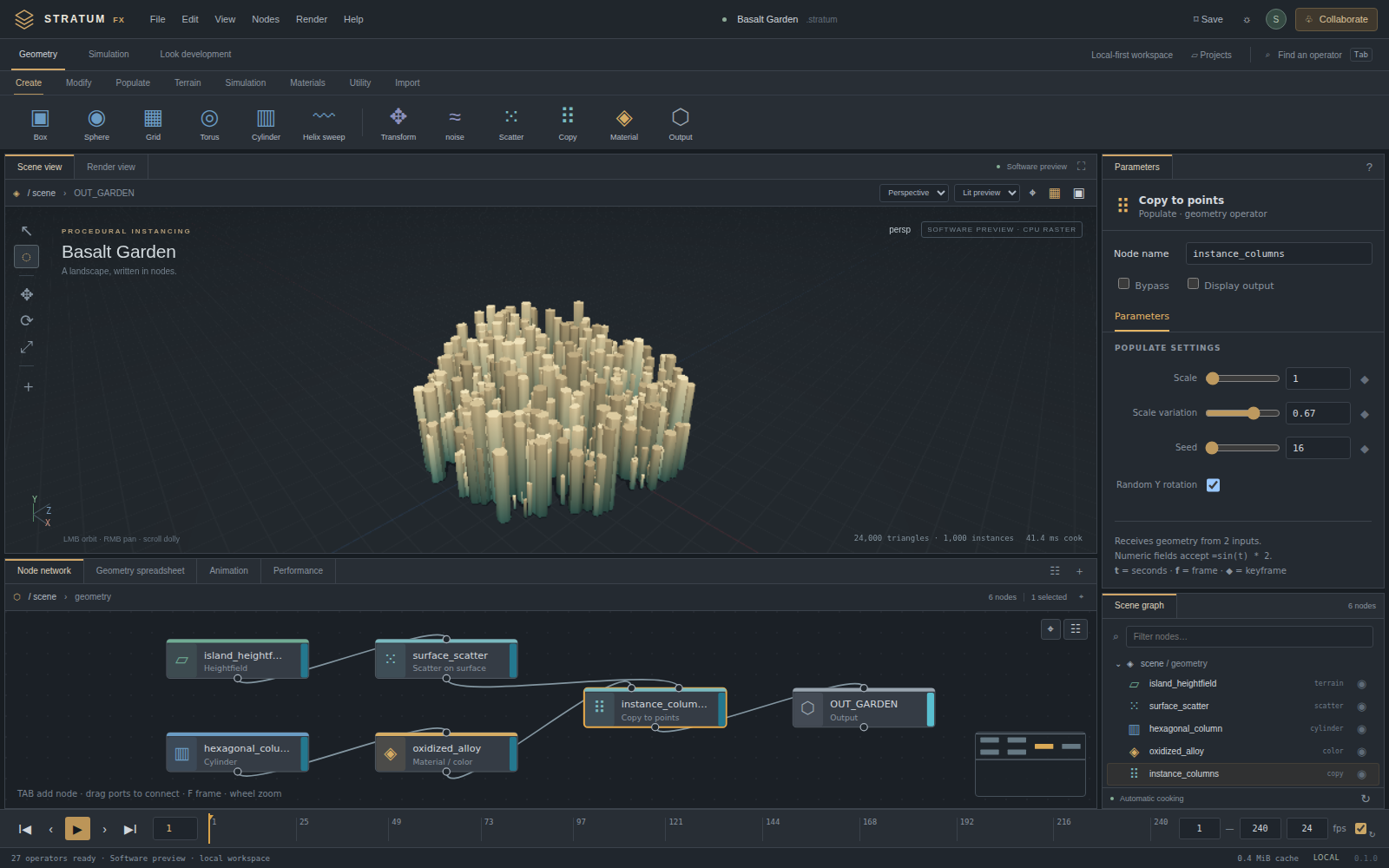
A linked viewport, node network, parameter inspector, and geometry spreadsheet keep your scene and its construction visible together.
Primitives, heightfields, seeded scattering, deformations and GPU instancing. Every operator stays in the graph, ready to change.
Explore procedural instancing ↗Safe mathematical expressions, numeric keyframes and timeline playback. Explore bounded cloth, ballistic particles and rigid sphere simulations.
Open the cloth study ↗Pick geometry, move transform handles, inspect point data and review cook timings. Save a project, export OBJ or STL, or capture a PNG.
Open the sculpture study ↗The native WebGPU renderer uses instanced draw calls, GGX/Schlick material shading, directional shadow maps and multisample antialiasing. The graph cooks off the UI thread in a Web Worker.
Without a usable GPU, the workspace falls back to WebGL2 or a labeled CPU depth-buffered preview. Fallbacks deliberately expose their reduced rendering capabilities.
Try the standalone renderer ↗import { Viewport } from
'@stratum-fx/renderer';
import { torus } from
'@stratum-fx/geometry';
const view = await new Viewport(canvas)
.init();
view.setMesh(torus(2, 0.4));
view.frame();Native GPU driver paths are implemented but not hardware-qualified in this delivery. Browser checks ran on the software preview.
The studio is one consumer of the libraries. Build your own editor, add a procedural viewport to another app, or use the geometry engine without a browser.
Typed arrays, primitives, deformation, instancing and interchange.
↓02CoreValidated graphs, extensible operators, expressions and edit history.
↓03RendererNative WebGPU, fallback backends, cameras and geometry picking.
↓04ControlsNode editor, schema-driven inspector and timeline custom elements.
↓05CollaborationIndexedDB projects, live replication and persistent offline edit queues.
↓Self-contained ES modules, browser-global bundles, TypeScript declarations and MIT licenses. These downloads are local-installable package archives, not claims of registry publication.
The included Node server provides accounts, team projects, invitations, live presence and operation streaming. SQLite stores committed edits and checkpoints.
Independent field changes merge. Same-field changes follow server arrival order. Rejected edits are surfaced rather than silently discarded. This is not a CRDT or an enterprise identity system.
Set up a team workspace ↗Stratum FX 0.1 is an independent, bounded procedural studio—not a feature-equivalent or file-compatible Houdini replacement. The scope matrix and test report document what is implemented and what is not.
Read the release boundaries ↗